Anthropic's Model Hardware Standard Puts AI in Robots
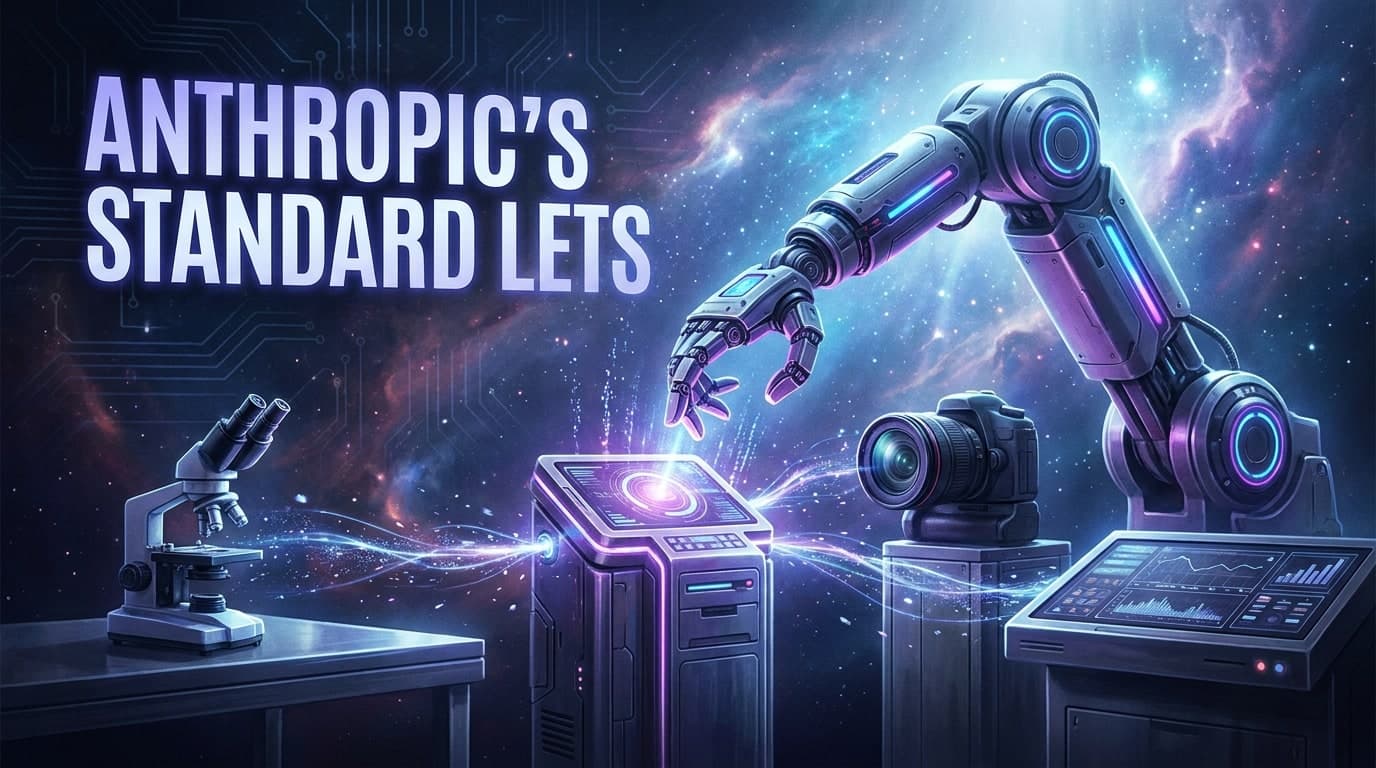
Anthropic released a new standard letting its Claude AI agents plug into robotic arms, lab instruments, and cameras. Rather than custom code per device, Claude issues commands through one shared interface. This is a real signal of AI moving off screens and into physical hardware.
What actually happened
Anthropic calls the system the Model Hardware Standard, or MHS, releasing it as a research preview, per Ars Technica. MHS gives AI agents one interface for lab equipment, robotic arms, and cameras, replacing custom code per device. Anthropic staffer Alek Kemeny said the idea came from watching neuroscientist Arco Bast wire lasers, microscopes, and cameras at the HHMI Janelia Research Campus in Ashburn, Virginia. 'This idea could be used to have AI run any science experiment in the world,' Kemeny said. Anthropic says MHS cuts integration time from weeks or months to hours or minutes. Early partners include Amazon Web Services, Hugging Face, Raspberry Pi, Automata, and Universal Robots.
How we got here
Until now, AI agents mostly stayed inside software, writing code, browsing pages, generating images. MHS builds on Anthropic's Model Context Protocol, which first let models call outside tools and data. The new layer adds standard tags for weight, range, safety limits, and adjustable settings, letting an agent reason about hardware it has never touched. Anthropic showed Claude picking up an aluminum can with an unfamiliar robotic arm, then calibrating a laser and microscope using camera feedback.
Why this matters for you
For everyday wallet users, this is not about token prices today. It is about where AI agents go next: off phones and into physical devices, including future wearables. For builders in the bonuz ecosystem, an open, agent-agnostic standard means hardware makers will not need separate AI integrations for every model, lowering the barrier for smart glasses and connected gadgets. For device makers like Universal Robots and Automata, early support for MHS could shape which hardware AI agents favor first.
The bigger question
Anthropic says it is building safety evaluations during this preview period. But as AI agents move from typing on screens to operating lasers, robotic arms, and lab tools, one question stays open: how much control should AI hold over machines that can cause real harm? And who sets that limit, the AI company, the hardware maker, or the person standing next to the machine?
What to watch
Anthropic has not set a public date for moving MHS out of research preview. It plans to open source the standard after more testing with AWS, Hugging Face, Raspberry Pi, Automata, and Universal Robots. Watch for safety evaluation results and a longer partner list. bonuz.market will track MHS as a marker for how AI moves from software into wearable hardware.