Bitcoin Quantum-Resistant Signature Proposal Goes Live
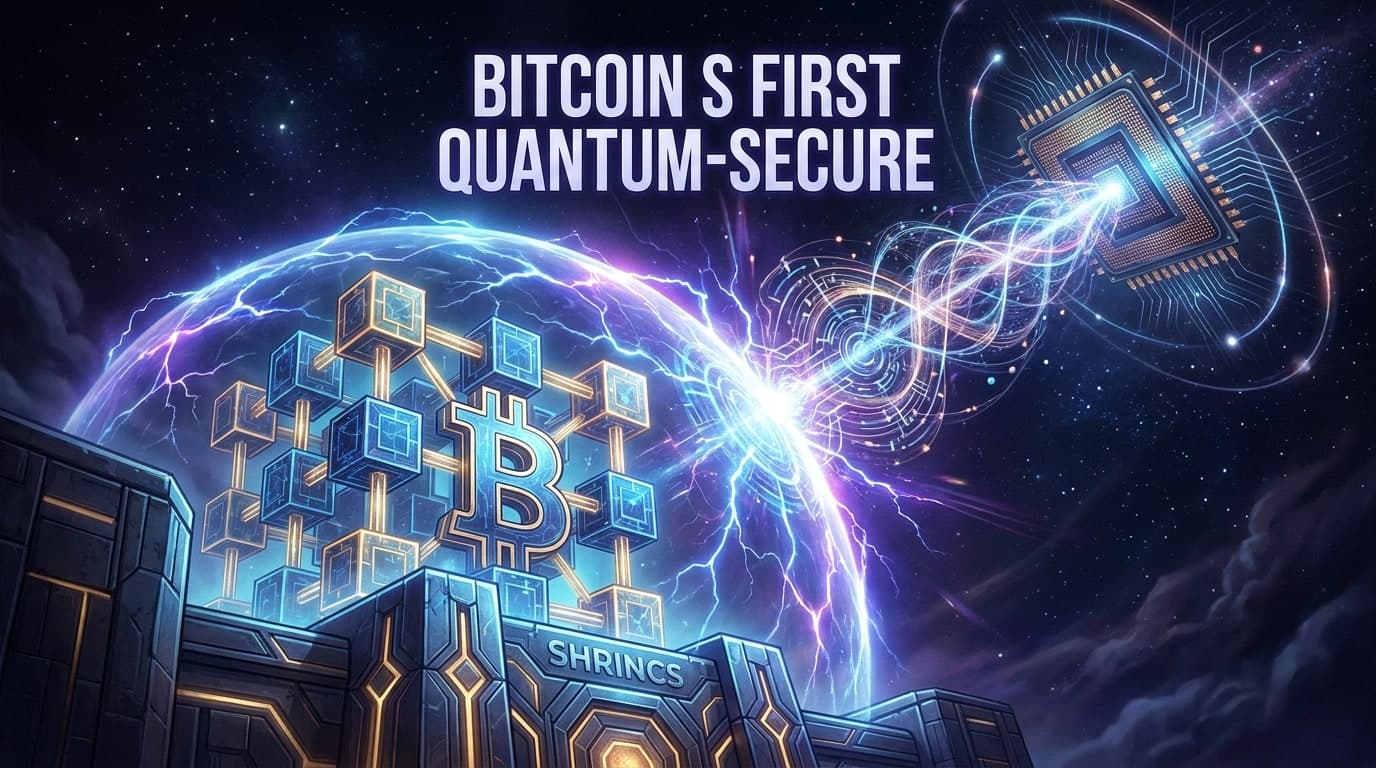
Blockstream, the company behind Bitcoin's Liquid sidechain, submitted a formal proposal on 27 August 2026 for signatures built to resist quantum computers. The move matters because it targets a risk that could eventually touch every Bitcoin wallet, no matter how it is held.
What actually happened
Blockstream researcher Jonas Nick called SHRINCS 'the first concrete proposal for a post-quantum signature scheme designed specifically for Bitcoin,' according to Cointelegraph. A SHRINCS signature runs at least 548 bytes plus a 48-byte public key, up to 4,619 bytes, about nine times larger than today's 64-byte Schnorr signatures. SegWit's witness discount means Blockstream still expects roughly 3 transactions per second, near current speed. Bitcoin traded at $79,661, up 1.33% in 24 hours, with $30.03 billion (USD) in volume and a $1.60 trillion (USD) market capitalisation. US spot bitcoin ETFs logged an eight-day, $2.8 billion (USD) inflow streak, reports CoinDesk, putting August on pace for its best month since October 2025.
How we got here
Blockstream researchers unveiled SHRINCS in December 2025 and added an opcode design in May 2026. They tested it on the Liquid sidechain in March 2026, signing sample transactions. Co-founder Adam Back doubts a quantum attack will land for decades, but calls early preparation 'the safe thing' to do. NIST-approved alternatives like SPHINCS+ and ML-DSA are far heavier, cutting throughput to 0.36 and 0.5 transactions per second, which is why a Bitcoin-native option drew attention.
Why this matters for you
For everyday holders, nothing changes today. SHRINCS is unaudited, and its own document lists the security proof as 'TODO'. No wallet needs to act now. For builders, including teams working on bonuz.market integrations, the complexity is real: SHRINCS is stateful, so devices must track used keys, and a lost device needs a roughly 5,777-byte recovery transaction. Researcher Yoon Auh warned every new consensus rule becomes 'a permanent maintenance obligation.' Core Lightning node operators should also watch for a security patch, since offline mode may be the only safe option until it ships.
The bigger question
If quantum computers ever threaten Bitcoin's keys, can a decentralized network settle on one upgrade path in time? SHRINCS now competes with proposals like BIP-360 and BIP-361, and split support could stall progress. One researcher suggested the real limit may be governance, not the underlying cryptography. Who ultimately decides, and how fast can that decision happen?
What to watch
Core Lightning's promised security update had no confirmed date as of 27 August 2026. Three trading days remain this month to see if August closes as the best month for bitcoin ETF inflows since October 2025. Separately, a Nevada court sentences Brent Kovar on 30 November 2026 over a $24 million (USD) mining Ponzi scheme, a reminder that scams still shadow genuine protocol progress.