CoreWeave Debt Crunch Tests Ethereum-Born AI Clouds
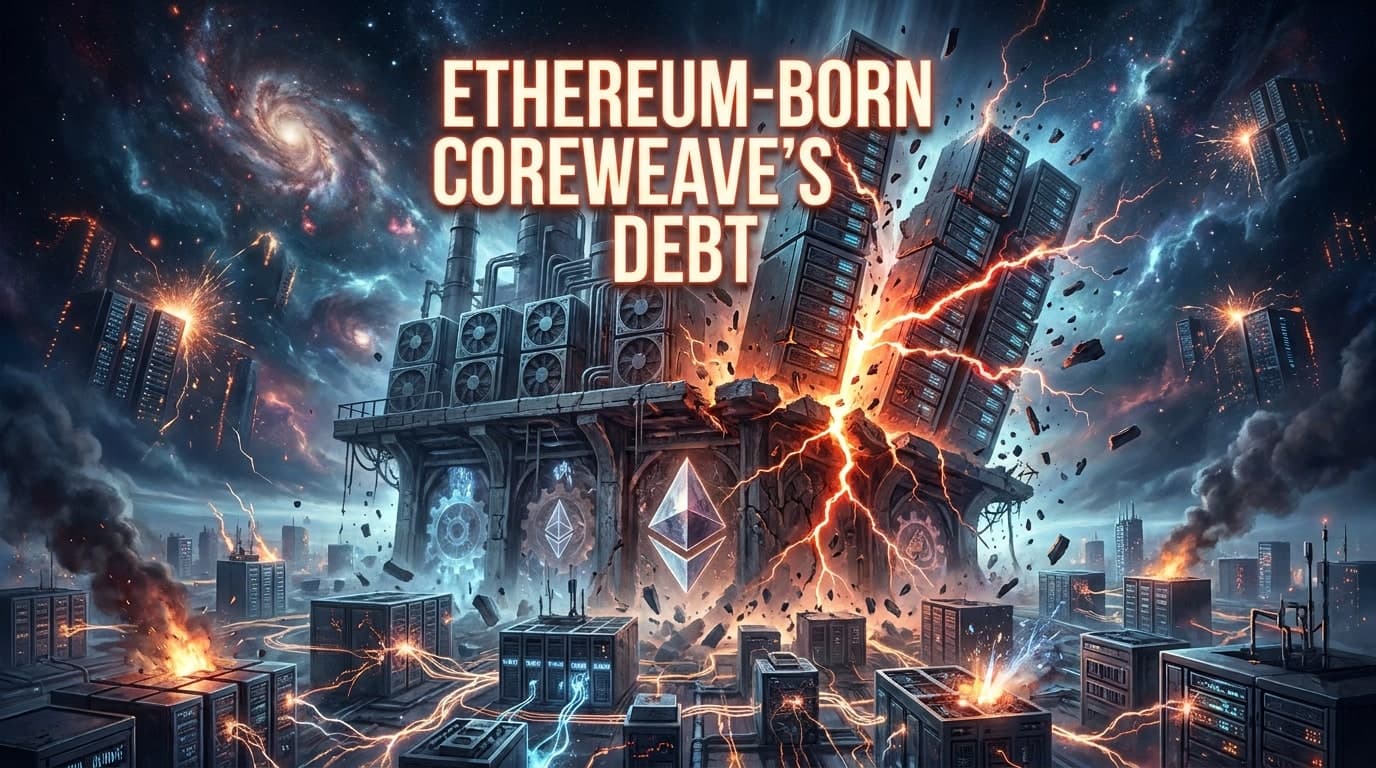
CoreWeave, the cloud giant that once mined Ethereum, saw its stock and bonds crash in mid October 2026, pulling AI chip stocks down with it. Wallet holders should care: the firm shows how old Ethereum mining hardware now powers the AI boom, carrying real credit risk attached.
What actually happened
Bond yields on some of CoreWeave's unsecured debt climbed near 15% in mid October 2026. One note due 2031 briefly topped 16%, according to Wu Blockchain. Shares dropped close to 25% over the week ending 16 October 2026, while the Philadelphia Semiconductor Index fell more than 11% in the same stretch. Second quarter 2026 revenue hit $2.575 billion (USD), up about 112% year over year, yet CoreWeave posted a $626 million net loss and $640 million in net interest costs. Total debt reached $35.6 billion by the end of June 2026. Microsoft supplied roughly 67% of CoreWeave's 2025 revenue. ETH itself traded at $2,332, down 0.59% over 24 hours, per CoinGecko data cited in reporting.
How we got here
CoreWeave launched in 2017 as Atlantic Crypto, an Ethereum mining outfit founded by Michael Intrator, Brian Venturo, and Brannin McBee. It bought discounted GPUs during the 2018 to 2019 downturn, then pivoted to cloud services in 2020 under its current name. When Ethereum completed the Merge in September 2022, moving to proof of stake, CoreWeave's IPO filings said it had fully stopped mining. The company listed on Nasdaq in March 2025 at a $1.5 billion valuation. Separately, Decrypt reported that OpenAI said its model disproved the Exponential Time Hypothesis, a math conjecture also shortened to ETH, confusing some crypto traders online.
Why this matters for you
For everyday ETH holders, there is no direct balance sheet link since mining ended in 2022. But CoreWeave shows where that old mining capacity landed: AI clouds serving Microsoft, OpenAI, Meta, and Anthropic. If lenders keep tightening terms for neoclouds, GPU expansion could slow, touching AI tools some wallet apps and crypto builders rely on. For bonuz users, remember: ETH's price barely moved this week. CoreWeave's credit stress is a separate, distinct risk, not a crypto market signal.
The bigger question
Gartner projects that more than 80% of neocloud providers will lose independence by 2030. If companies born from Ethereum mining anchor AI's credit risk today, what happens to the broader buildout once borrowing costs keep climbing? Does consolidation make this infrastructure sturdier, or does it simply gather the same risk into fewer hands? No one has a clean answer yet.
What to watch
CoreWeave's third quarter 2026 results will show whether interest expense lands inside its guided $860 million to $940 million range. Anthropic's compute capacity under its CoreWeave deal should start coming online later in 2026. Researchers led by Ryan Williams are still checking OpenAI's Exponential Time Hypothesis claim, with no fixed deadline. bonuz.market will keep watching how this affects wallet-adjacent AI tooling.