Ethereum's zkAPI Hides Your Wallet From AI Services
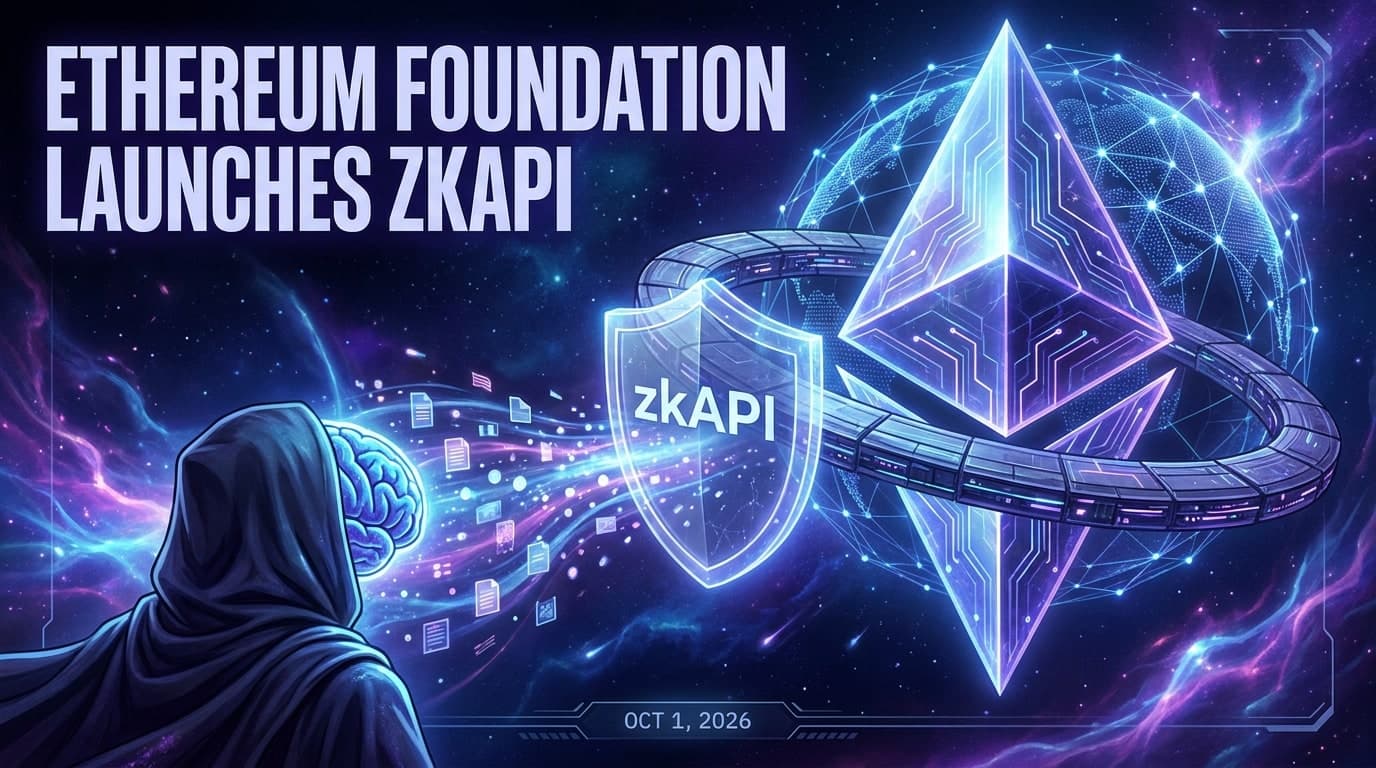
On 1 October 2026, the Ethereum Foundation switched on zkAPI, a tool letting people pay for AI services without tying the payment to their identity. For anyone using a crypto wallet to access AI tools, this changes how much of your activity stays private.
What actually happened
zkAPI went live on Ethereum's main network on 1 October 2026, built jointly by the Ethereum Foundation and the Open Anonymity Project, according to The Block. Users lock ETH or USDC into a vault contract, which stores the balance as a private note. A zero-knowledge proof then authorizes spending without exposing which deposit funded it. Ken Liu of the Open Anonymity Project described it as 'a generalization of OA unlinkable inference that also abstracts payments away,' in an X post. On the same day, developer Jerome de Tychey confirmed EIP-8363, a plan to burn part of staking rewards, was dropped from the upcoming Hegota upgrade, per The Block. Layer-2 network Blast also said it will shut down, citing unsustainable costs, with $63.5 million (USD) still sitting in its bridge. ETH traded at $2,696, up 0.78% in 24 hours, with volume at $17.83 billion (USD) and a market cap of $329.29 billion (USD).
How we got here
The zkAPI design traces back to a research post Vitalik Buterin and Ethereum Foundation lead Davide Crapis published on 11 February 2026. The Foundation built its dAI team in September 2025 to position Ethereum as a settlement layer for AI agents, following January 2026's ERC-8004 agent identity standard. Buterin has framed this as part of Ethereum becoming a 'cryptographic world computer,' according to Wu Blockchain, with Hegota possibly the last upgrade old-school developers would recognize. The EIP-8363 removal shows that changing how ETH issuance works still needs wider agreement than a routine scoping call can deliver.
Why this matters for you
For everyday wallet holders, zkAPI means an AI subscription or query no longer has to leave a trail linking back to your address, though network traffic itself is not hidden and the code is still marked experimental. For builders inside ecosystems like bonuz, it offers a ready template for private, metered payments beyond chat tools, covering image generation, data queries, and machine-to-machine transactions between AI agents. For ETH stakers, the EIP-8363 withdrawal confirms monetary policy changes face a high bar before going live. For Layer-2 users generally, Blast's shutdown is a reminder that even active networks can close down.
The bigger question
zkAPI proves that identity-free payment for AI services already works on Ethereum today. If AI companies adopt this widely, less usage data will be tied to individual wallets or accounts. Does an AI industry that has always relied on tracking usage to train and refine its models keep improving once a large share of its payments become anonymous by default?
What to watch
Blast users have until 26 October 2026 to withdraw funds through its standard bridge; after that, only contract-level withdrawals work. The Hegota upgrade is expected sometime next year. zkAPI stays labeled experimental, so expect audits and expanded use cases, including agent-to-agent payments, before wallets built on bonuz or elsewhere adopt it widely.