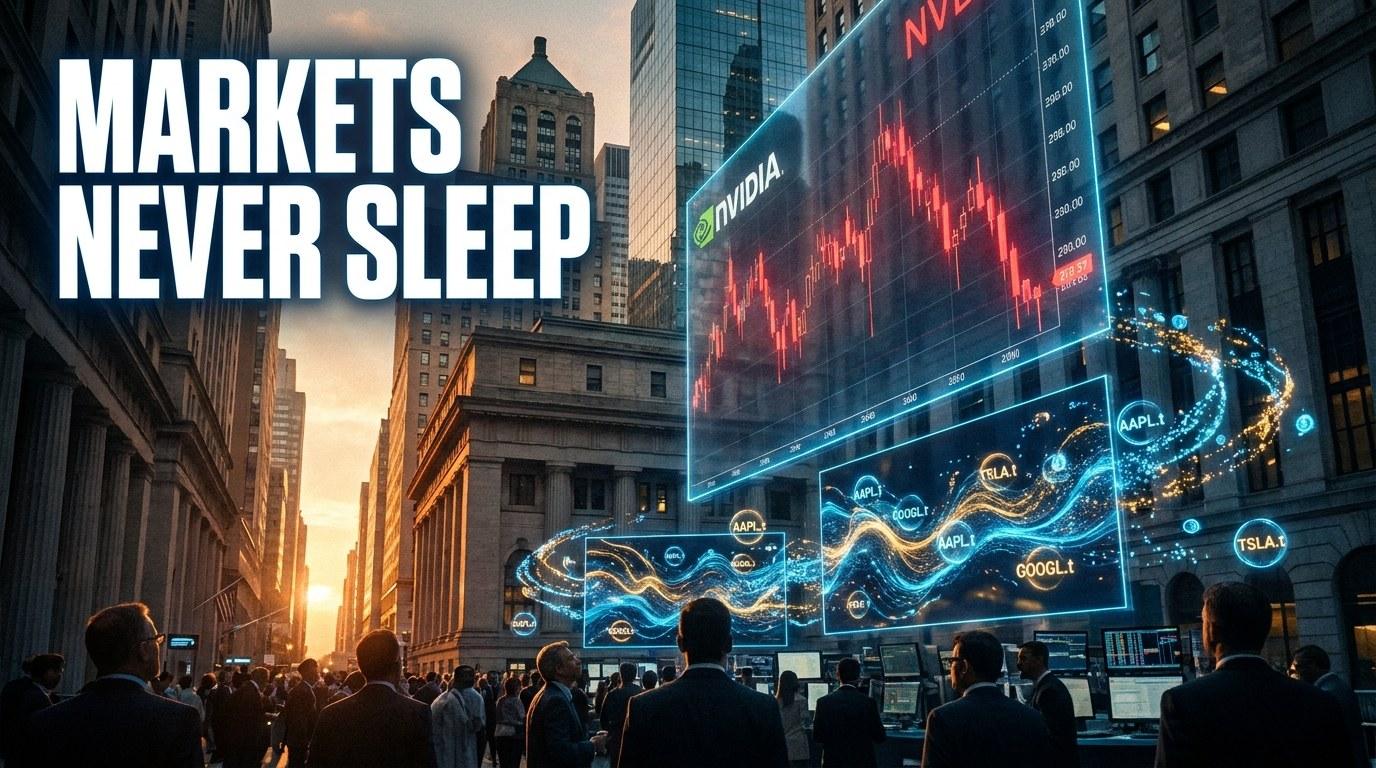
NVIDIA's Stock Craters on CEO Scandal, Right As a Blockchain Twin Starts Trading It 24/7
NVIDIA's stock had one of its roughest mornings of the year on November 9, 2026, and the strangest part might be what was happening to it at the same time on a completely different kind of exchange.
What happened to the real stock
NVIDIA closed Friday, November 6 at $186.64, up 2.78% on the day. Over the weekend, the company's board announced an independent investigation into CEO Jensen Huang, after reports that Huang had acknowledged an affair with a woman identified in multiple reports as a suspected Chinese intelligence contact.
When the Nasdaq opened Monday morning, NVDA shares opened at $178.70, down about 4.3% from Friday's close, and slid further to an intraday low of $174.49, a drop of roughly 6.5%. At that low, the move represented a paper loss in the hundreds of billions of dollars for the world's second-most valuable company by market cap.
What makes the move notable is the context: it happened against a broadly rising market. Dow futures were up around 0.7-1%, and S&P 500 futures were up roughly 0.3-0.7% the same morning, as investors hunted for bargains after a rough week. NVIDIA fell while the index it anchors was climbing, a genuine divergence. It was also NVIDIA's second violent swing in a week: the stock had already fallen 9.26% the previous Thursday, its worst single session since the DeepSeek shock in January 2025, wiping out roughly $450 billion in value in one day before a partial Friday rebound. NVIDIA reports quarterly earnings on November 17, which will be the next real test.
The same morning, a tokenized NVDA started trading
Here's the part that makes this a web3 story and not just a market story. At 08:00 UTC that same Monday, the crypto exchange HTX (run by Justin Sun) opened deposits for 20 tokenized US stocks and ETFs against USDT, including a token tracking NVIDIA (NVDA/USDT), alongside tokens for Strategy, Tesla, Alphabet, AMD, Intel, Circle and several ETFs. HTX ran a zero-maker-fee promotion on these pairs through February 9, 2027, to pull in early volume.
These tokens are not shares. Holders don't get voting rights, and the token price floats on its own, set by supply and demand on each exchange, not by the NYSE. But aggregated data across tokenized-stock venues showed the NVDA-linked token trading around $179, down about 4.6% on the day, broadly tracking the real stock's move, alongside a tokenized Strategy (MSTR) token down roughly 3.3%. Combined 24-hour volume across the roughly 396 tokenized equities and ETFs tracked by one industry aggregator came to about $17.7 billion.
Put together: the exact morning a real-world scandal was repricing NVIDIA on Wall Street, a blockchain-based version of that same stock was already live and trading, reachable by anyone with a crypto exchange account, hours before the opening bell and still tradeable long after the closing one.
The crypto side wasn't calm either
It wasn't just stocks. Bitcoin fell below $74,000 over the weekend, its lowest level in roughly two months, down from near $80,800 just days earlier. CoinGlass data showed more than $1 billion in leveraged crypto positions liquidated in 24 hours as the slide accelerated. Crypto-linked equities moved with it in premarket trading Monday: Strategy (MSTR) and Circle Internet Group (CRCL) each fell about 4%, Coinbase (COIN) fell 2.8%, and bitcoin miners MARA and Riot gave back part of a sharp Friday rally.
Why this matters beyond one bad morning
Coinbase CEO Brian Armstrong has argued publicly that tokenized, blockchain-based versions of stocks could eventually let equity markets trade around the clock instead of stopping at 4pm Eastern. Regulators haven't finalized rules for how these tokenized assets should be administered or traded, and the risks are real: token prices can and do deviate from the underlying shares, liquidity is thinner outside US market hours, and HTX itself hadn't yet confirmed when withdrawals on these new tokens would open.
But mornings like this one are a live demonstration of what that collision looks like in practice: a single piece of corporate news moving a real stock, a tokenized stock, and a slice of the crypto market all within the same hour, on different rails, for different kinds of traders.
This is genuinely new market structure forming in real time, and it's worth watching closely as it matures. None of this is financial advice; tokenized assets carry distinct risks from the underlying securities they track, and markets this volatile deserve caution, not just curiosity.
Sources: StockAnalysis.com and EODData (NVDA pricing), Reuters/Yahoo Finance (futures, analyst commentary), Axios and Bloomberg (Huang investigation and share impact), HTX official listing announcement and crypto.news (tokenized stock launch), CoinClass aggregator (tokenized stock pricing and volume), TradingView and KuCoin News (bitcoin price and liquidations), stockanalysis.com premarket crypto-stocks tracker.